
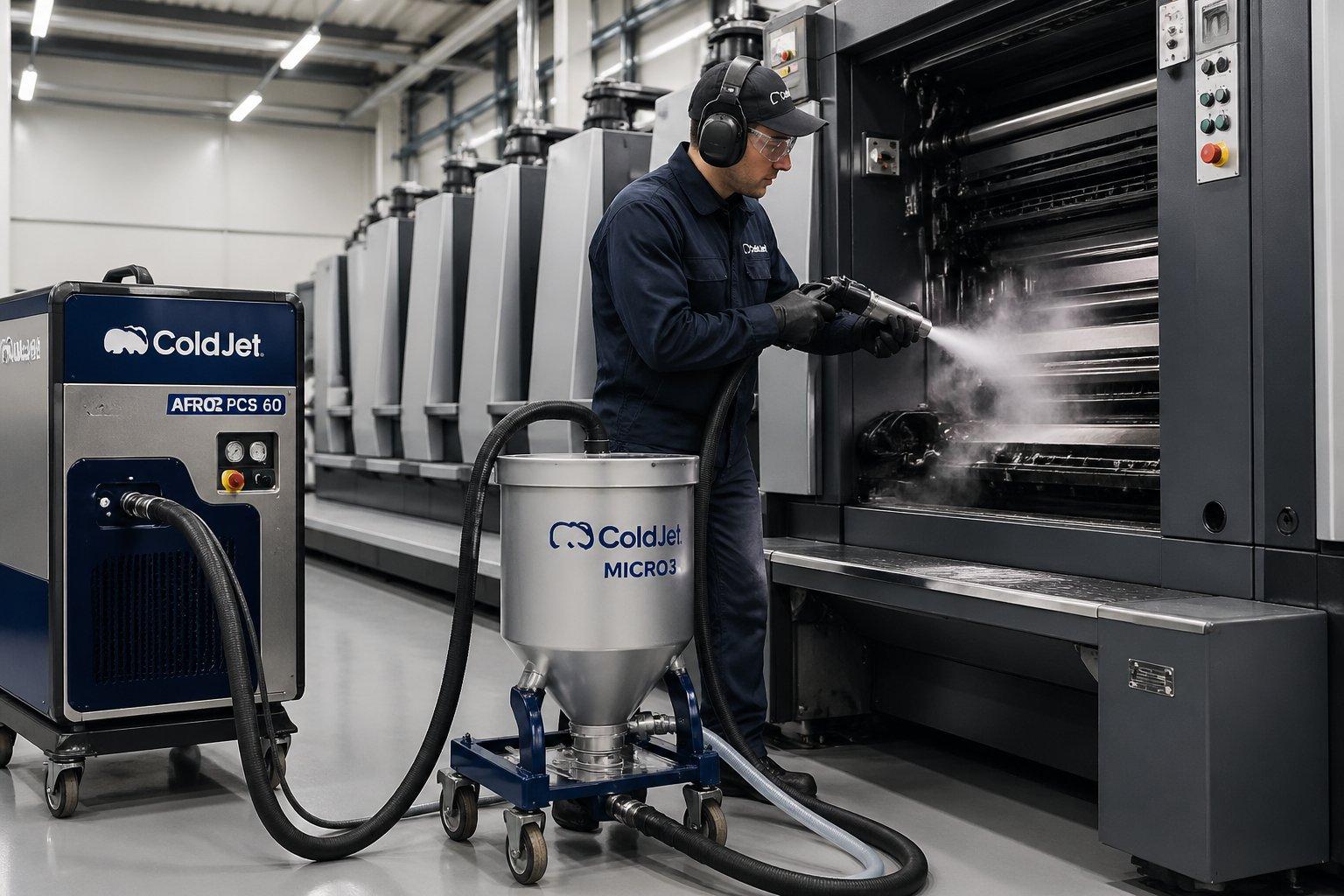
Residue buildup, unplanned downtime, and the need to protect sensitive components continue to challenge operators seeking efficient ways to clean in place printing press systems without disruption. Traditional cleaning methods—such as abrasive blasting, water-based processes, or chemical applications—often require partial disassembly, extended drying times, or risk to delicate surfaces. As an alternative, Nu-Ice Blasting™ offers industrial dry ice blasting equipment designed to clean effectively without secondary waste or moisture. By enabling direct, in-place cleaning, the technology supports faster maintenance cycles and helps reduce printing downtime with dry ice, while maintaining production efficiency through a fast printing press cleaning approach that minimizes operational interruptions.
Dry ice blasting is an industrial cleaning method that uses solid carbon dioxide (CO₂) pellets accelerated by compressed air to remove contaminants from surfaces. The process involves directing a high-velocity stream of dry ice pellets at targeted areas, where they impact and break apart unwanted buildup. Upon contact, the pellets rapidly sublimate, changing from solid to gas without producing liquid residue. This eliminates the need for secondary cleanup associated with water or chemical methods. Because the process is dry and non-conductive, it can be used on sensitive equipment and in-place machinery without introducing moisture or additional waste streams.
Kinetic Impact
Dry ice pellets are accelerated at high speeds using compressed air. When they strike a surface, the kinetic energy helps loosen contaminants such as grease, ink, or buildup without damaging the underlying material.
Thermal Shock
The extremely low temperature of dry ice creates a rapid temperature difference upon contact. This causes contaminants to contract and become brittle, weakening their bond with the surface.
Sublimation Expansion
After impact, dry ice pellets convert directly from solid to gas. This rapid expansion lifts and dislodges loosened contaminants, allowing them to be removed without leaving secondary waste behind.
A dry ice blasting machine includes several essential components that work together to deliver controlled cleaning performance. An air compressor supplies the pressurized air needed to accelerate the pellets. The dry ice hopper stores the pellets and feeds them into the system during operation. A metering system regulates the amount of dry ice entering the air stream, allowing for adjustable cleaning intensity. The hose transports the mixture of compressed air and pellets to the application point. Finally, the nozzle directs and concentrates the stream onto the surface being cleaned, enabling precise and efficient contaminant removal without moisture or disassembly.
Nu-Ice Dry Ice Blasting is an industrial equipment manufacturer founded in 1998, specializing in the production of dry ice blasting systems. The company designs and manufactures its equipment in the United States, focusing on durable construction and compatibility with standard industrial air systems. Nu-Ice Blasting™ machines are engineered to support consistent pellet flow and controlled application across a variety of cleaning environments. Their equipment is used in industries where maintaining operational continuity is important, including applications that benefit from reducing printing downtime dry ice methods. By enabling cleaning without moisture or disassembly, the systems support more efficient maintenance processes. The company’s focus remains on manufacturing reliable dry ice blasting equipment for industrial users requiring consistent and repeatable cleaning performance.
Nu-Ice Blasting™ equipment incorporates several functional features designed to support controlled dry ice cleaning operations. The systems include a blasting gun that allows operators to direct the flow of dry ice pellets with precision. Interchangeable nozzle options are available to adjust the pattern and concentration of the blasting stream depending on the application. An integrated moisture separator is included to remove water vapor from the compressed air supply, helping maintain consistent airflow during operation. In addition, an aftercooler can be used to reduce the temperature of compressed air before it enters the system. These components work together to regulate air quality, pellet delivery, and application control within standard industrial cleaning setups.
Nu-Ice Blasting™ systems are manufactured with specifications suited for industrial use. Equipment dimensions and weight vary by model, typically designed for mobility while maintaining stability during operation. Hopper capacity is configured to hold a sufficient volume of dry ice pellets for continuous use without frequent refilling. Air flow requirements generally align with standard industrial compressors, with operating ranges depending on the specific unit. Pressure ranges are adjustable to accommodate different cleaning conditions and surface requirements. Dry ice consumption is controlled through the system’s metering mechanism, allowing operators to regulate pellet usage during operation. These specifications reflect general system configurations intended for compatibility with common industrial environments and cleaning applications.
Preparation and Setup
The process begins by connecting the dry ice blasting unit to a suitable compressed air source and loading dry ice pellets into the hopper. Proper inspection of hoses, fittings, and connections is conducted before operation.
Safety Requirements
Operators typically wear appropriate protective equipment, including gloves, eye protection, and hearing protection. Adequate ventilation is also maintained to manage carbon dioxide levels during use.
Typical Workflow Steps
Once activated, compressed air propels the dry ice pellets through the system and out of the nozzle. The operator directs the stream toward the target surface, adjusting air pressure and pellet flow as needed. The process continues in a controlled manner until the cleaning cycle is complete, after which the system is shut down and depressurized.
Nu-Ice Blasting™ equipment is used across a range of industrial and commercial environments where dry, non-abrasive cleaning methods are required. In manufacturing and production facilities, the systems are applied to machinery, molds, and processing equipment to remove buildup without dismantling components. In food processing environments, dry ice blasting is used for sanitation-related cleaning on production lines and equipment where moisture introduction is limited. The method is also applied in historical restoration projects and on delicate surfaces, where preservation of the underlying material is important.
Additional applications include automotive and aerospace industries, where components, tooling, and assembly equipment require controlled cleaning processes. Electrical and power generation environments also utilize dry ice blasting equipment for cleaning around sensitive systems. Specialty cleaning applications extend to areas where traditional abrasive or liquid-based methods may not be suitable, allowing operators to address contamination while maintaining operational conditions.
Dry ice blasting is a cleaning process that does not generate secondary waste, as the dry ice pellets sublimate upon impact. The method is non-abrasive, allowing it to be used on a variety of surfaces without altering the underlying material. It is also a dry, chemical-free process, eliminating the need for water or solvents during operation. Environmental considerations include proper ventilation due to carbon dioxide release, as well as handling and storage of dry ice materials. In industrial settings, the ability to reduce printing downtime dry ice processes are associated with can support more efficient maintenance scheduling while maintaining equipment cleanliness without additional cleanup requirements.
Nu-Ice Blasting™ systems can be configured with a range of accessories to support different operational requirements. Interchangeable nozzles and hose options allow operators to adjust the direction, reach, and pattern of the blasting stream for various applications. The equipment is designed to integrate with standard industrial air supplies, and aftercoolers may be used to condition compressed air before it enters the system. Proper storage of dry ice and routine inspection of hoses, fittings, and components are part of regular maintenance considerations. These elements contribute to consistent system operation within typical industrial environments.
Frequently Asked Questions (FAQs)
How does dry ice blasting remove contaminants without leaving residue?
Dry ice blasting uses solid CO₂ pellets accelerated by compressed air to strike contaminants. Upon impact, the pellets sublimate directly into gas, expanding and lifting debris from the surface without creating liquid residue or additional waste streams.
Is dry ice blasting suitable for sensitive electronics or delicate equipment?
Dry ice blasting is a dry, non-conductive process that does not introduce moisture. This allows it to be used on sensitive equipment and electrical components, provided proper operational controls and safety procedures are followed during cleaning.
What air pressure and supply requirements are needed for dry ice blasting equipment?
Dry ice blasting systems typically rely on standard industrial compressed air sources. Adjustable pressure ranges allow operators to control cleaning intensity, while consistent airflow ensures proper acceleration of pellets through the system during operation.
How should dry ice pellets be stored and handled before use?
Dry ice pellets must be stored in insulated containers to reduce sublimation loss. They should be handled with protective gloves and used within a practical timeframe, as the material naturally converts from solid to gas when exposed to ambient conditions.
What safety measures are required when operating dry ice blasting systems?
Operators are generally required to use personal protective equipment such as gloves, eye protection, and hearing protection. Adequate ventilation is necessary to manage carbon dioxide levels, especially in enclosed environments where gas accumulation may occur.
How does dry ice blasting compare environmentally to traditional abrasive cleaning methods?
Dry ice blasting does not produce secondary waste because the pellets sublimate on impact. Unlike abrasive methods, it avoids additional disposal requirements and eliminates the need for chemical cleaning agents, reducing overall environmental handling considerations.
In which industries is dry ice blasting commonly applied?
Dry ice blasting equipment is used in manufacturing, food processing, automotive, aerospace, and restoration applications. It is applied to machinery, production lines, molds, and surfaces where dry, controlled cleaning methods are required without introducing moisture.
Nu-Ice Dry Ice Blasting continues to manufacture industrial cleaning equipment designed for integration into standard operational environments where controlled, dry cleaning methods are required. Since its founding in 1998, the company has focused on producing systems in the United States that support consistent pellet delivery and compatibility with commonly available compressed air infrastructure. Its equipment is applied across a range of industries where maintaining equipment condition without introducing moisture or secondary waste is a consideration. By enabling cleaning processes that can be performed without disassembly, dry ice blasting systems are incorporated into routine maintenance workflows in manufacturing and other industrial settings. As industries continue to evaluate efficient cleaning approaches, dry ice blasting remains a method utilized where dry, non-abrasive processes are appropriate for operational requirements.