
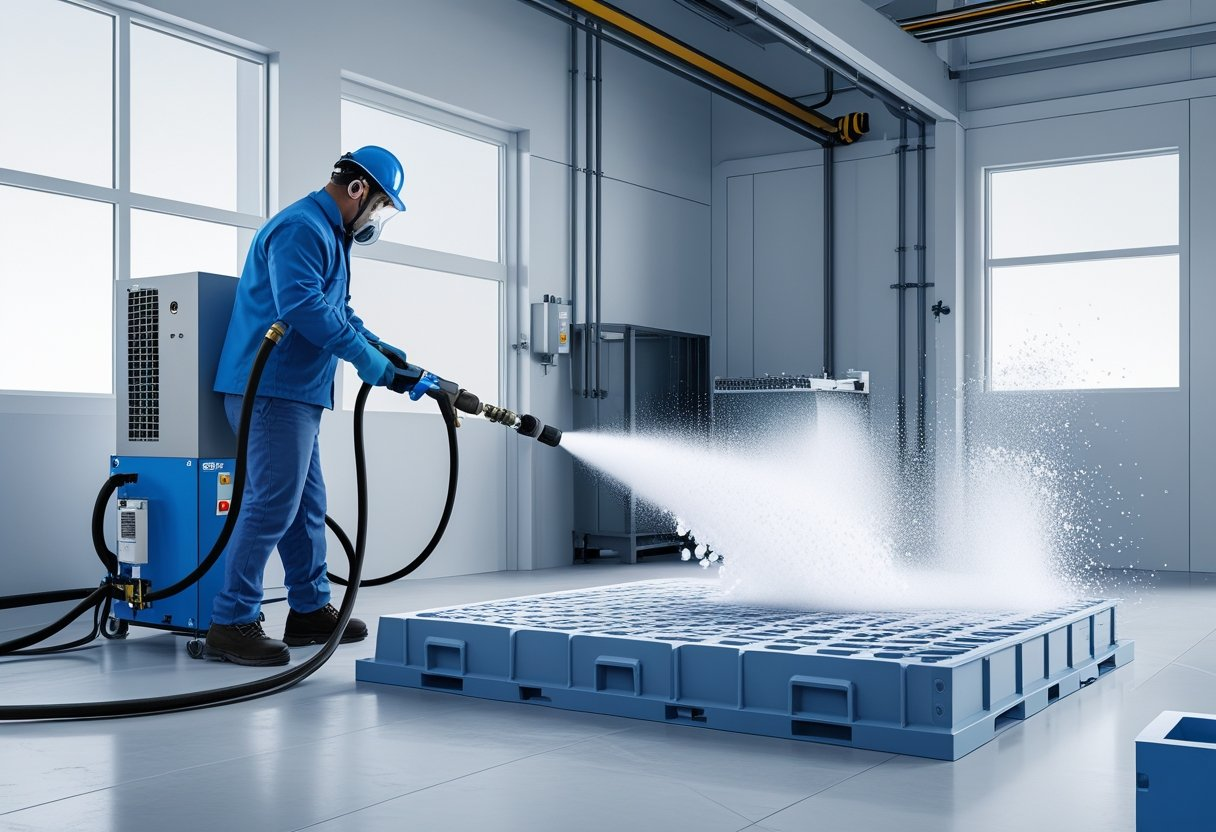
Manufacturers working with rubber molds often face persistent challenges from residue buildup, including release agents, polymer accumulation, and heavy grease that can disrupt production efficiency and extend downtime. Traditional cleaning approaches—such as abrasive blasting, chemical solvents, or manual scrubbing—can risk surface damage, introduce secondary waste, or require lengthy shutdowns. As an industrial dry ice blasting equipment manufacturer, Nu-Ice Blasting™ provides a dry, non-abrasive cleaning alternative designed to address these issues. Through dry ice release agent removal, this method enables effective contaminant elimination while preserving mold integrity, supporting faster turnaround times, and reducing the need for harsh chemicals in sensitive industrial environments.
Dry ice blasting is a cleaning process that uses solid carbon dioxide (CO₂) pellets propelled by compressed air to remove contaminants from surfaces. The equipment feeds dry ice pellets through a pressurized system, accelerating them toward the target area where cleaning is required. Upon impact, the pellets rapidly transition from solid to gas in a process known as sublimation. This phase change leaves no residual blasting media behind, distinguishing it from abrasive or liquid-based methods. Because the dry ice converts directly into gas, the process minimizes secondary waste while enabling effective cleaning across sensitive industrial surfaces.
Kinetic Impact
Dry ice pellets are accelerated using compressed air, creating sufficient velocity to dislodge surface contaminants. The mechanical force helps break the bond between the residue and the substrate.
Thermal Shock
The extremely low temperature of dry ice introduces a rapid cooling effect on contact. This temperature differential can cause contaminants to become brittle, weakening their adhesion to the surface.
Sublimation Expansion
When dry ice pellets sublimate from solid to gas, they expand in volume. This expansion occurs beneath the contaminant layer, helping lift and separate it from the underlying material without abrasive action.
A dry ice blasting system consists of several key components that work together to deliver consistent cleaning performance. The air compressor supplies the compressed air required to propel dry ice pellets through the system. The dry ice hopper stores and feeds the pellets into the machine, maintaining a controlled supply. A metering system regulates the amount of dry ice introduced into the airflow, allowing for adjustment based on cleaning requirements. The hose transports the air and pellet mixture to the application point, while the nozzle directs and focuses the stream onto the target surface, enabling precise and efficient cleaning.
Nu-Ice Blasting™ is a U.S.-based manufacturer of dry ice blasting equipment, producing systems designed for industrial cleaning applications. Founded in 1999, the company focuses on engineering and manufacturing equipment in the United States, supporting a range of industries that require non-abrasive and residue-free cleaning methods. Its systems are designed to utilize dry ice pellets in combination with compressed air to remove contaminants without introducing water or chemical solvents. This approach aligns with operational needs where surface preservation and reduced cleanup are priorities. In applications such as dry ice blasting polymer buildup, the equipment enables effective removal of accumulated materials while minimizing downtime. By manufacturing its systems domestically, Nu-Ice Blasting™ maintains control over production and design processes, ensuring consistency across its equipment offerings.
Nu-Ice Blasting™ dry ice blasting equipment incorporates several functional components designed to support controlled and consistent operation. The blasting gun serves as the primary interface for directing the stream of dry ice pellets and compressed air, allowing operators to manage application across different surfaces. Interchangeable nozzle options are available to adjust the flow pattern and intensity, enabling adaptation to various cleaning requirements and geometries. Systems may also include integrated moisture separation components that help remove water from the compressed air supply, supporting consistent pellet delivery. In addition, aftercooler units can be used in conjunction with compressors to reduce air temperature and moisture content before entering the blasting system. These features work together to maintain stable operating conditions throughout the cleaning process.
Nu-Ice Blasting™ equipment is manufactured in a range of configurations with specifications suited to industrial environments. Typical systems are designed with compact, portable dimensions that allow for maneuverability within production settings while maintaining structural durability. Equipment weight varies depending on the model and configuration, supporting both stationary and mobile use. Hopper capacity is designed to hold a sufficient volume of dry ice pellets to enable continuous operation over defined intervals. Airflow requirements generally align with standard industrial compressors, with adjustable ranges to accommodate different cleaning intensities. Operating pressure ranges are configurable to match application needs, while dry ice consumption rates can be regulated through the machine’s metering system. These specifications collectively support adaptable operation across a variety of industrial cleaning scenarios.
Preparation and Setup
The process begins with connecting the dry ice blasting unit to a suitable air compressor and ensuring a clean, dry air supply. Dry ice pellets are loaded into the hopper, and system settings such as air pressure and pellet feed rate are adjusted.
Safety Requirements
Operators typically use appropriate protective equipment, including eye and hand protection, and ensure adequate ventilation due to carbon dioxide gas release during operation.
Typical Workflow Steps
Once activated, the system delivers dry ice pellets through the hose and nozzle using compressed air. The operator directs the stream toward the target surface, moving systematically across the area. Adjustments to pressure and feed rate may be made during operation to maintain consistent application. After completion, the system is shut down and remaining dry ice is managed according to standard handling procedures.
Nu-Ice Blasting™ equipment is used across a range of industrial and commercial environments where controlled, non-abrasive cleaning methods are required. In manufacturing and production settings, the equipment is applied to machinery, molds, and tooling to address buildup that occurs during routine operations. Within food processing and sanitation environments, dry ice blasting equipment is utilized in areas where moisture-sensitive cleaning methods are preferred, supporting maintenance of production equipment.
The technology is also applied in historical restoration and preservation projects, where delicate substrates require careful treatment without abrasive contact. In automotive and aerospace sectors, equipment is used for cleaning components, assemblies, and production tools, while in electrical and power-related environments, it can be applied to equipment where minimal residue is necessary. Additional specialty applications include cleaning in printing, plastics, and general industrial maintenance contexts, where surface integrity and controlled cleaning processes are important considerations.
Dry ice blasting operates without generating secondary waste, as the dry ice pellets sublimate into gas upon impact, leaving only the removed contaminants to be collected. The process is non-abrasive, allowing it to be used on surfaces that may be sensitive to mechanical wear. It is also a dry method that does not rely on water or chemical solvents, supporting use in environments where moisture or residue must be minimized. Proper ventilation is required due to carbon dioxide release, and operators must ensure appropriate handling of compressed air systems. In applications such as rubber mold residue cleaning, the process supports controlled contaminant removal while maintaining surface condition.
Nu-Ice Blasting™ systems can be configured with a range of accessories to support different operational requirements. Nozzle options allow operators to adjust the shape and intensity of the blasting stream, while hose configurations provide flexibility in reaching confined or complex areas. Integration with an appropriate air supply system is essential, often including components such as aftercoolers to manage air temperature and reduce moisture content. Proper storage of dry ice and routine equipment maintenance are also important considerations, ensuring consistent system performance and reliable operation across various industrial environments.
Frequently Asked Questions (FAQs)
Is dry ice blasting suitable for industrial use?
The process is widely used in industrial environments when proper operating procedures are followed. Standard precautions include wearing protective equipment and ensuring adequate ventilation due to CO₂ gas release.
What facility requirements are needed for operation?
Facilities generally need access to compressed air, proper ventilation, and space for equipment handling. Storage considerations for dry ice pellets are also important due to their sublimation over time.
How does dry ice blasting differ from traditional abrasive methods?
Unlike abrasive cleaning, dry ice blasting does not use hard media to erode surfaces. It relies on pellet impact, temperature effects, and sublimation to remove contaminants without adding secondary materials.
Does dry ice blasting generate waste?
The process does not create additional blasting waste because dry ice converts directly into gas. Only the removed contaminants remain, which may need to be collected depending on the application.
Can it be used on sensitive or delicate surfaces?
Dry ice blasting is often applied where surface preservation is important. As a dry and non-abrasive method, it is suitable for equipment and materials that require controlled cleaning conditions.
What is dry ice blasting?
Dry ice blasting is a cleaning method that uses solid CO₂ pellets propelled by compressed air. Upon impact, the pellets sublimate into gas, removing contaminants from surfaces without leaving behind additional blasting media.
What equipment is needed to perform dry ice blasting?
A typical setup includes a dry ice blasting machine, a compatible air compressor, and a supply of dry ice pellets. Supporting components such as hoses, nozzles, and air treatment systems may also be used.
As industries continue to evaluate efficient and controlled cleaning methods, dry ice blasting equipment remains a practical option for operations requiring minimal disruption and surface preservation. Nu-Ice Blasting™ has focused on the design and manufacturing of dry ice blasting systems in the United States since its founding in 1999, supporting a range of industrial applications where traditional cleaning approaches may present limitations. By utilizing solid CO₂ pellets and compressed air, the equipment provides a dry, non-abrasive process that aligns with environments where residue management and operational continuity are important considerations. With ongoing use across manufacturing, processing, and maintenance settings, dry ice blasting systems continue to be integrated into routine cleaning workflows where consistency and controlled application are required.